
Fuel prices remain one of the biggest day-to-day costs for UK drivers. While prices can change frequently, one thing has become increasingly clear: the amount you pay often depends on where you fill up, not just when you fill up.
Recent market monitoring by the Competition and Markets Authority (CMA) highlights why drivers can no longer rely on assumptions or habit when buying fuel — and why price comparison is now more important than ever.
Prices can vary sharply within short distances
One of the most striking features of the UK fuel market is how much prices can differ between nearby petrol stations. It’s not unusual to see:
- Differences of 5–10p per litre between stations a few miles apart
- Higher prices in areas with fewer alternatives
- Unexpected price gaps even between stations of the same brand
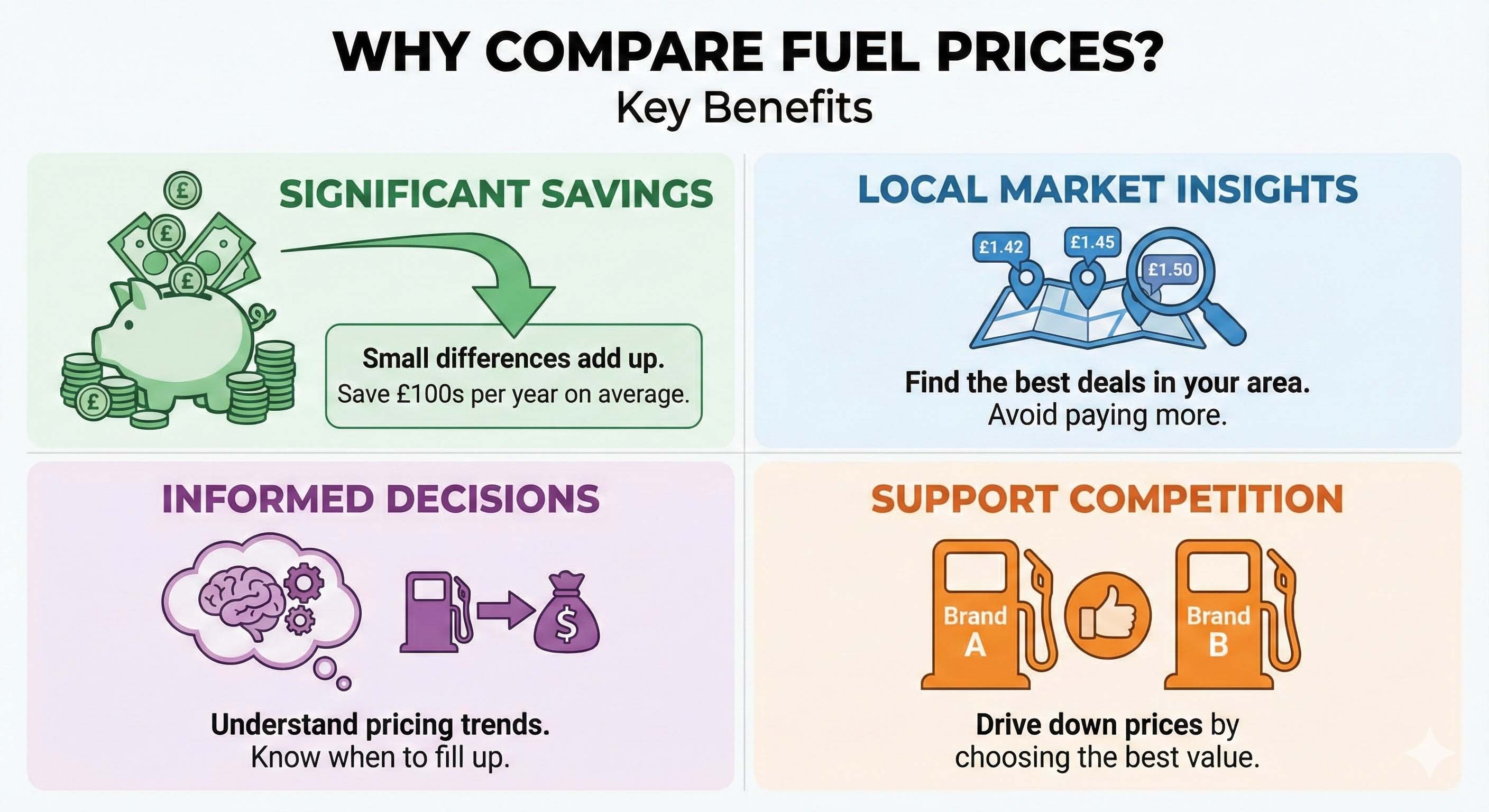
These variations are often invisible unless drivers actively check prices before filling up.
Wholesale price drops don’t always reach the pump quickly
Fuel prices tend to rise quickly when wholesale costs increase, but fall more slowly when those costs come down.
This delay means drivers who don’t compare prices may continue paying higher prices even when cheaper options are available nearby. Comparing prices helps identify stations that respond more quickly to falling costs.
Competition is uneven across the UK
The level of competition between petrol stations varies widely depending on location.
In areas with several nearby stations, prices are usually more competitive. In areas with limited choice, prices tend to stay higher for longer. Because competition is uneven, relying on a single “local” station can result in consistently paying more than necessary.
Supermarket fuel isn’t always the cheapest
Many drivers assume supermarket petrol stations always offer the lowest prices. While they are often competitive, this isn’t guaranteed.
In some locations, supermarket stations face little local competition, or independent stations may undercut them. In other cases, prices stay high because drivers expect supermarkets to be cheaper without checking. Comparing prices removes guesswork and reveals the real cheapest option at that moment.
Small differences add up over time
The Savings Add Up
A saving of just a few pence per litre may not seem significant, but over a year it can make a noticeable difference.
- Saving 4p per litre on a 50-litre fill saves £2
- Over 50 fills a year, that’s £100 saved
These savings come from simple choices, not changes in driving habits.
Transparency is improving — but drivers must use it
More fuel price data is becoming available, making it easier to see what stations are charging. However, transparency alone doesn’t reduce costs unless drivers act on it.
Drivers who check prices before setting off, are willing to travel a short extra distance, and avoid filling up out of habit are best placed to benefit from improved price visibility.
Convenience can quietly cost more
Time pressure, routine and convenience often lead drivers to fill up at the same station repeatedly. Over time, this can mean paying a consistent premium without realising it.
Price comparison allows drivers to balance convenience with cost — choosing when it’s worth paying a little extra, and when it isn’t.
Why comparison tools matter now more than ever
With fuel margins remaining higher than historic norms and competition varying by area, comparison tools play a crucial role in helping drivers make informed choices.
They help drivers:
- Spot cheaper stations nearby
- Avoid persistently high-priced locations
- Respond to market changes rather than guessing
As fuel prices continue to fluctuate, this ability becomes increasingly valuable.
The bottom line
Fuel prices in the UK are influenced by more than just oil costs. Local competition, pricing behaviour and timing all affect what drivers pay at the pump. In this environment, comparing fuel prices isn’t just helpful — it’s one of the easiest ways for drivers to stay in control of their fuel costs. Checking prices before filling up has never mattered more.