
Petrol prices in the UK often feel unpredictable. One week prices rise sharply, the next they barely move — or don’t fall at all. While many factors are blamed for changes at the pump, not all of them have the same impact.
Understanding what really affects petrol prices — and what doesn’t — can help drivers make sense of price movements and avoid common misconceptions.
What does affect petrol prices
1. Wholesale fuel costs
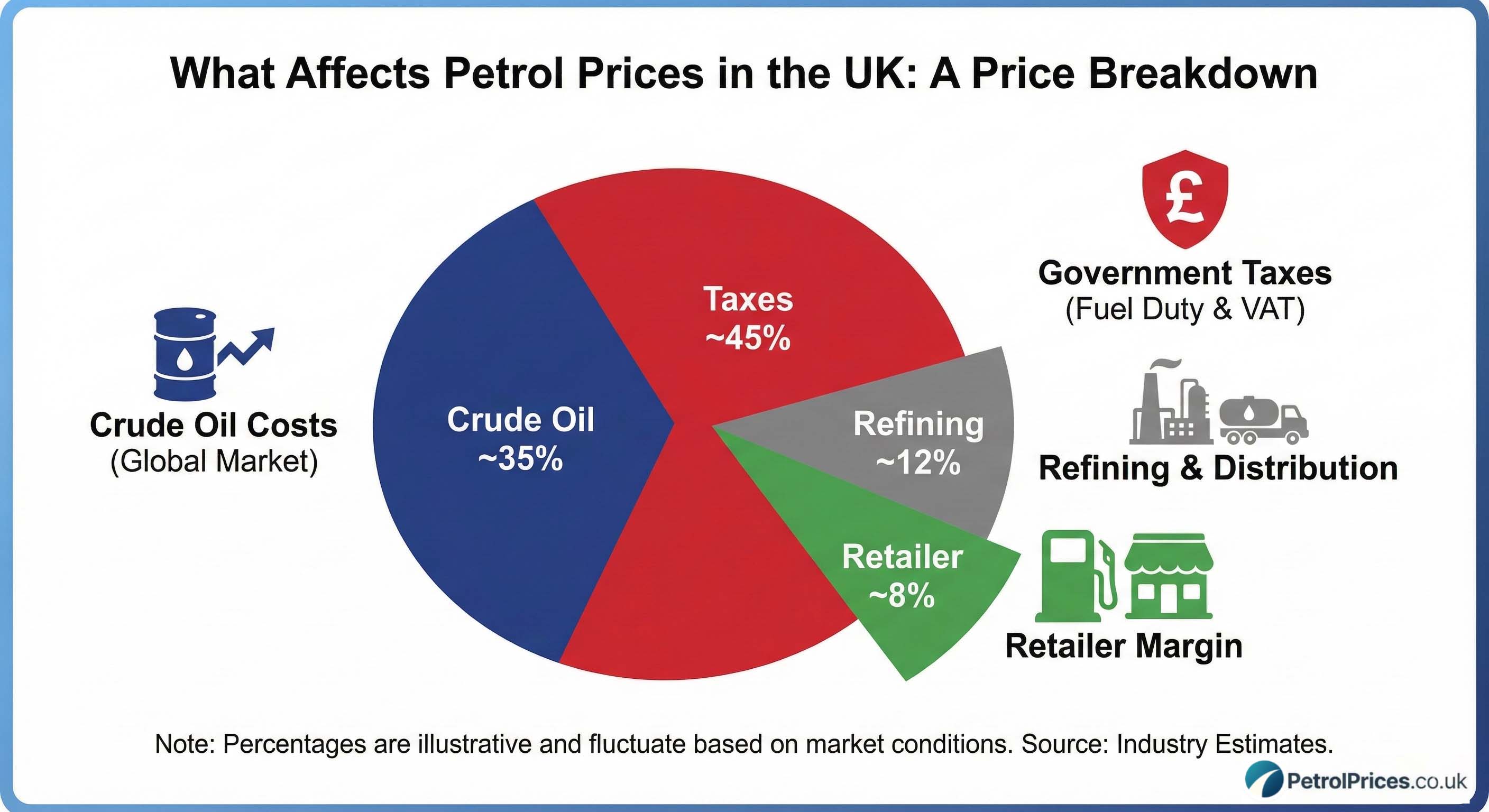
Wholesale costs are one of the biggest drivers of pump prices. They are influenced by:
- Global oil prices
- Refining and distribution costs
- Exchange rates, particularly the pound against the dollar
When wholesale costs rise, pump prices usually follow quickly. When they fall, the effect is often slower and less consistent.
2. Fuel duty and VAT
A significant portion of the pump price is made up of tax. Fuel duty is charged per litre, and VAT is applied on top of the total price.
Because these taxes are fixed or applied consistently, they don’t explain short-term price changes — but they do set a high baseline price that limits how low fuel prices can fall.
3. Local competition
Competition between nearby petrol stations has a major influence on price. Areas with several competing stations tend to see lower prices, while areas with limited choice often have higher, slower-moving prices. Local competition can matter more than brand or location.
4. Retailer pricing behaviour
Retailers decide when and how much to change prices. Some respond quickly to wholesale cost changes, while others delay reductions to protect margins. Recent monitoring by the Competition and Markets Authority shows that pricing behaviour plays a bigger role than many drivers realise.
5. Regional factors
Transport costs, supply routes and local demand can influence prices slightly, particularly in remote or rural areas. However, these differences are usually smaller than many people expect.
What doesn’t fully explain petrol prices
Drivers often hear other reasons for high prices, but official analysis suggests they don't tell the whole story.
1. Staff wages
While wages have increased, analysis suggests they do not explain why fuel prices stay elevated when wholesale costs fall. Wage costs are a small part of the overall fuel margin.
2. Energy bills at petrol stations
Energy costs affect operating expenses, but they have not risen enough to justify long-term higher fuel margins across the market.
3. Investment in EV charging
Some retailers point to electric vehicle charging investment as a reason for higher fuel prices. However, this cost is not closely linked to fuel pricing and does not fully account for persistent price increases.
4. Crime and security
Security costs exist, but they vary widely by location and do not explain national pricing patterns or prolonged high margins.
5. “Global uncertainty”
While global events can affect oil prices, they don’t explain why pump prices sometimes remain high after those pressures ease.
Why prices don’t always behave as expected
The One-Way Feeling
One of the biggest frustrations for drivers is seeing prices rise quickly but fall slowly. This creates the feeling that prices only move in one direction — even when market conditions change.
This happens because cost increases are passed on immediately, while cost decreases are often delayed, and competition doesn’t always force rapid price cuts.
Why checking prices matters
Because petrol prices are influenced by local competition and retailer behaviour, two nearby stations can charge very different prices on the same day.
Drivers who:
- Compare prices before filling up
- Avoid assumptions about brands
- Check prices regularly
are far more likely to benefit when prices fall.
The bottom line
Petrol prices in the UK are shaped by wholesale costs, taxes, competition and retailer behaviour — not just by rising wages or operating expenses. Many commonly cited explanations don’t fully account for why prices stay high or fall slowly. In a market where pricing behaviour varies widely, the most reliable way for drivers to protect themselves is to compare prices and choose where to fill up carefully.