
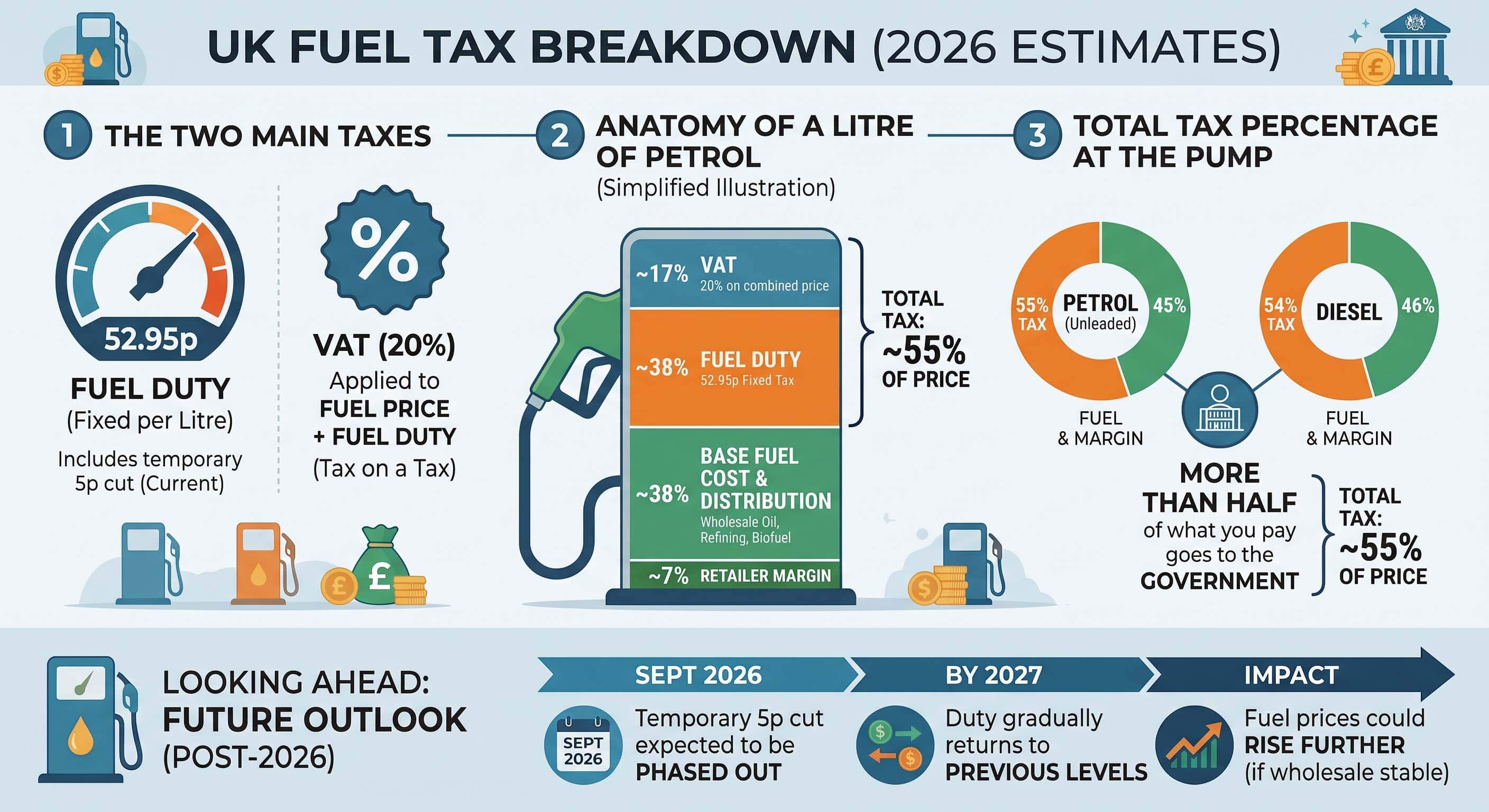
How fuel is taxed in the UK
There are two main taxes on fuel in the UK. Both apply every time you fill up, and together they make up more than half of what you pay.
1. Fuel Duty (fixed per litre)
Fuel duty is a flat tax charged on every litre of petrol or diesel sold in the UK. It doesn't change with the price of oil — it's the same fixed amount regardless of what fuel costs on the open market.
The current rate is 52.95p per litre. This includes a temporary 5p cut first introduced in March 2022, which has been extended several times and remains in place until 31 August 2026. Before the cut, the rate was 57.95p per litre — itself frozen since 2011.
2. VAT (20%)
VAT is charged at 20% on fuel — but importantly, it's applied to the total price including fuel duty. This means you're effectively paying tax on a tax, which increases the overall tax burden beyond what many drivers realise.
Tax on a tax: Because VAT is calculated on the price that already includes fuel duty, the government collects VAT on both the fuel itself and the duty it has already charged. At current rates, this adds roughly 10.6p per litre in VAT on the duty alone.
What percentage of fuel is tax?
Tax makes up a large share of the pump price — and the exact percentage changes depending on how much fuel costs before tax is applied.
At current pump prices, more than half of every litre goes to the government. When fuel prices drop, the tax share actually increases — because fuel duty is fixed regardless of price. At lower pump prices, tax can account for 65–75% of what you pay.
Example: how a litre of petrol is priced
Here's a simplified breakdown of a litre of unleaded petrol at a typical 2026 pump price of around 140p:
| Component | Approx. pence |
|---|---|
| Wholesale fuel cost (oil + refining) | ~44p |
| Bio content (E10) | ~7p |
| Delivery & oil company costs | ~2p |
| Retailer margin | ~10p |
| Fuel Duty | 52.95p |
| VAT (20% on total) | ~23p |
| Total pump price | ~140p |
| Total tax (duty + VAT) | ~76p (54%) |
Fuel duty is often the single largest component of the pump price — larger than the cost of the fuel itself in many cases.
Why is fuel taxed so heavily?
Fuel tax is one of the UK government's largest single sources of revenue. In 2025/26, fuel duty alone is expected to raise around £24–25 billion — equivalent to roughly £850 per household. It serves multiple policy purposes:
- Revenue — fuel duty is a significant contributor to public finances, helping fund roads, public services and infrastructure.
- Environmental policy — higher fuel costs are intended to encourage reduced consumption and lower emissions.
- Behavioural incentive — the tax provides a financial reason for drivers to choose more fuel-efficient vehicles or consider alternatives.
However, fuel duty has faced growing political pressure. The main rate was frozen for over a decade from 2011, and the 5p cut introduced in 2022 has been extended multiple times. The cumulative cost to the Treasury of these freezes and cuts has been estimated at around £120 billion since 2011.
When will fuel duty increase?
After 15 years of freezes, fuel duty is set to rise from September 2026. The temporary 5p cut will be phased out in three stages:
1 September 2026 — +1p per litre
Duty rises from 52.95p to 53.95p per litre. With VAT on top, the actual pump price increase is around 1.2p per litre.
1 December 2026 — +2p per litre
Duty rises to 55.95p per litre. Cumulative pump price increase of around 3.6p per litre including VAT.
1 March 2027 — +2p per litre
Duty returns to 57.95p per litre — the rate before the 2022 cut. Total pump price increase of around 6p per litre including VAT.
April 2027 onwards — annual RPI increases
From 2027/28, fuel duty will rise each year in line with inflation (RPI) for the first time since 2011.
What this means for drivers: For a typical 55-litre tank, the full 5p duty increase will add around £2.75 per fill-up — or roughly £5–6 more per tank once VAT is included. Over a year, a driver covering 7,500–8,000 miles could pay around £55–90 more in fuel tax than today.
It's worth noting that there are growing calls from motoring groups and opposition parties to delay or cancel the planned September increase, particularly given the impact of the Middle East conflict on oil prices. As of late March 2026, the government has said it keeps fuel duty "under review" but has not announced any change to the schedule.
Why fuel prices stay high even when oil falls
Because fuel duty is a fixed amount per litre rather than a percentage, it doesn't fall when oil prices drop. Even if the wholesale cost of fuel halved, you'd still pay 52.95p in duty on every litre plus 20% VAT on top.
This is why pump prices can feel stubbornly high even when headlines report falling oil prices. The tax floor means there's a minimum price drivers will always pay, regardless of what's happening in global markets.
The bottom line
Fuel in the UK is heavily taxed. You pay fuel duty on every litre, then VAT on top of that duty, and in total over half the pump price is tax. Understanding this breakdown helps explain why fuel prices can stay high even when oil prices fall — and why even small changes to duty rates matter to every driver's budget.
Save where you can: You can't avoid fuel tax, but you can avoid overpaying. Fuel prices vary by up to 20p per litre between nearby stations. Using a free price comparison tool before filling up can save several pounds per tank — every time.